База знань
AlmaLinux vs. Rocky Linux Роздрукувати цю статтю
AlmaLinux vs. Rocky Linux: A Comprehensive Guide to Choosing Your Ideal Enterprise Linux Distribution
In the evolving landscape of open-source operating systems, the emergence of AlmaLinux and Rocky Linux has become a focal point for businesses and developers alike. Both distributions aim to fill the void left by CentOS's shift to CentOS Stream, providing a stable RHEL (Red Hat Enterprise Linux) alternative. In this article, we will delve into the key differences between AlmaLinux and Rocky Linux, their advantages and disadvantages, and help you make an informed decision for your projects.
Understanding AlmaLinux and Rocky Linux
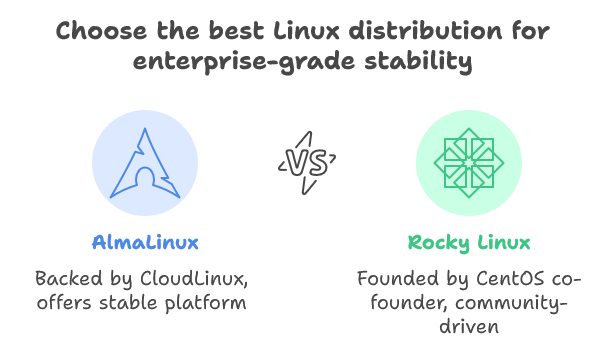
AlmaLinux is a community-driven, open-source, enterprise-grade Linux distribution that directly matches RHEL's binary compatibility. It emerged from the CloudLinux team, who wanted to provide a stable platform for servers and enterprise applications after CentOS shifted its direction.
Rocky Linux was founded by Gregory Kurtzer, one of the original co-founders of CentOS. Rocky Linux is also designed to be a drop-in replacement for CentOS, ensuring users have the stability and reliability they expect from an enterprise-level Linux system.
Key Differences Between AlmaLinux and Rocky Linux
-
Governance and Community:
- AlmaLinux is backed by CloudLinux, a commercial company, which provides financial support and resources for the project. Therefore, it has a more structured approach to governance.
- Rocky Linux, being community-driven, promotes an open governance model where decisions are made collectively by its contributors.
-
Release Cycle:
- AlmaLinux follows a predictable release cycle that aligns with Red Hat's release schedule, offering users clear expectations regarding updates and security patches.
- Rocky Linux also aims for alignment with RHEL but emphasizes community input, which may lead to variations in release timing based on contribution levels.
-
Focus and Future Development:
- AlmaLinux intends to develop additional tools and features that cater to enterprise users, including enhanced security features and a support network.
- Rocky Linux is primarily focused on retaining the "CentOS experience," making it attractive for users looking for continuity and familiarity.
Pros and Cons of AlmaLinux and Rocky Linux
Advantages and Disadvantages of AlmaLinux
Pros:
- Backed by CloudLinux: Offers financial backing and additional resources, which can be a strong point for long-term stability and support.
- Predictable Updates: Users can expect reliable updates and patches due to a well-structured release cycle.
- Enterprise Features: Additional tools and features enhance the overall experience for enterprise users.
Cons:
- Commercial Interest: Some may be skeptical about the motivations of a distribution that is backed by a commercial entity, fearing monetization of the software in the future.
- Smaller Community: Compared to Rocky Linux, AlmaLinux has a relatively smaller community, which may affect support options.
Advantages and Disadvantages of Rocky Linux
Pros:
- Community-Driven: Ensures transparency and inclusiveness in decision-making, fostering a culture of collaboration among users.
- Familiarity: Users migrating from CentOS will find Rocky Linux to be very much in line with their previous experiences.
- Flexibility: The project encourages community contributions, which can lead to a more diverse development approach.
Cons:
- Limited Commercial Support: While it is community-driven, Rocky Linux lacks the immediate commercial backing, which could affect long-term stability.
- Variation in Updates: The flexible community-driven model may lead to unexpected shifts in update schedules.
Key Takeaways: Which One Should You Choose?
Ultimately, the choice between AlmaLinux and Rocky Linux boils down to your specific needs and preferences regarding community involvement, support, and long-term stability.
If you prioritize a distribution with solid commercial backing, frequent updates, and support tailored for enterprises, AlmaLinux may be the way to go. Conversely, if you value a community-centered approach with a commitment to preserving the CentOS experience, Rocky Linux could be the better choice.
Frequently Asked Questions about AlmaLinux and Rocky Linux
1. Is AlmaLinux free to use?
Yes, both AlmaLinux and Rocky Linux are free to use, and they are open source, allowing modifications and distributions without any licensing fees.
2. Can I migrate from CentOS to AlmaLinux or Rocky Linux easily?
Yes, both distributions provide straightforward migration paths from CentOS, allowing for a seamless transition with minimal downtime.
3. Are there any paid support options for these distributions?
AlmaLinux offers commercial support through CloudLinux, while Rocky Linux, being community-driven, relies mostly on community forums and documentation for support.
4. Which distribution is more suitable for enterprise applications?
Both distributions are designed to be enterprise-ready. However, AlmaLinux may have an edge with its backing from CloudLinux, offering unique enterprise features and support.
5. Can I run AlmaLinux or Rocky Linux on cloud infrastructure?
Yes, both distributions are compatible with a variety of cloud environments, making them suitable for deployment in cloud infrastructures across different providers.
Unlock Exclusive Performance with H4F.NET's High-Performance VPS!
As you evaluate your Linux distribution choice, it's essential not to overlook the importance of the right web hosting provider. Consider H4F.NET for your hosting needs! Offering high-performance Virtual Private Servers (VPS) across Europe, the USA, and Asia, H4F.NET ensures your application runs smoothly and efficiently. Enjoy fast load times and top-notch customer support to complement your choice of AlmaLinux or Rocky Linux. Check out H4F.NET today for exclusive offers tailored to your hosting requirements!
Choosing between AlmaLinux and Rocky Linux involves weighing key factors, including support, governance, and community engagement. As both distributions continue to evolve, staying informed and connected will enable you to leverage the power of enterprise Linux platforms for your projects. Whether you choose AlmaLinux or Rocky Linux, you can be confident of a stable and reliable operating system designed specifically for the needs of the enterprise.
Ця відповідь Вам допомогла?
Схожі статті
Hi Thank you for choosing service from Host4Fun . Go to run > cmd > slmgr.vbs /rearm and...
By default Windows Server 2008 firewall blocks ping requests. To enable please follow the...
By default Windows Server 2012 firewall blocks ping requests. To enable please follow the below...
Hi , Thank you for choosing Service from Host4Fun.Com. When we run command "yum update" on our...
For Guide Visit :...